
Browse articles
- Practice details
- Brand your documents: logo, fonts, colours and artwork
- Project numbering
- Custom fields
- Task statuses
- Task types
- Adding an office
- Office billing details
- Give your people a home entity
- How permissions work
- Setting someone's access level
- Practice finances access
- Rates access
- Access to one project
- Project role access
- Project admin access
- Team role access
- What each access switch controls
- Contacts access
- Project creation access
- Expense claims access
- Report access
- Staff management access
- Sign-in security
- Verify your sending domain
- Activity and undo
- Connect your own AI agent
- Moving and linking stages
- Critical path and automatic dates
- Large projects
- How do I move a task to another stage?
- Billing milestones
- Checklists and notes
- Your projects
- Tracking schedule slips
- How do I change a project's status?
- How do I rename a project?
- Closing a project
- How do I archive or complete a project?
Rates on a project
See the rates one project charges and costs, choose whether rate changes reach it, agree a rate with the client that steps up partway through the job, and give one stage or task rates of its own.
What you'll achieve
See the rates a project uses, choose Locked or Dynamic for each side, and agree a rate with the client that changes partway through.
You'll end up with: The project charges the rate agreed with the client, stepping up on the agreed date, whatever later happens to the role's rate.
Before you start
Why a project needs its own rates
A role's rate is the practice's price list. A project is a deal with one client, and deals differ: a long-standing client negotiates a lower rate, a fee letter says the rate steps up after the first stage, or a job was quoted on last year's figures. Every project's Brief has a Rates section that answers two questions for that project: which rates does it use, and do rate changes reach it.
We'll use Riverside Apartments for City of Hawthorn. Its charge-out rates were locked at the quoted figures when the Senior Architect rate rose; see change a rate across your projects. Sarah Chen, a Senior Architect, is booked on it.
Rate changes: Locked or Dynamic
Under Rate changes, each side has its own answer:
- Locked keeps the amounts the project had on the day it was locked. Later changes to a role's, a person's or the practice's rate never reach it.
- Dynamic takes each rate change from its start date.
A common pattern is charge-out Locked, so the client pays what you quoted, and cost Dynamic, so pay rises still show in the project's margin.
- 1
Open the project, then its Brief, and go to Rates.
- 2
Under Rate changes, Charge-out rate reads Locked, with the date of the amounts it keeps. Cost rate reads Dynamic, Takes each rate change.
- 3
Under Rates in use, each person and role with work here shows their rate and where it comes from. Where a locked amount's role has moved on, today's figure shows in brackets, such as two hundred (now two hundred and ten).
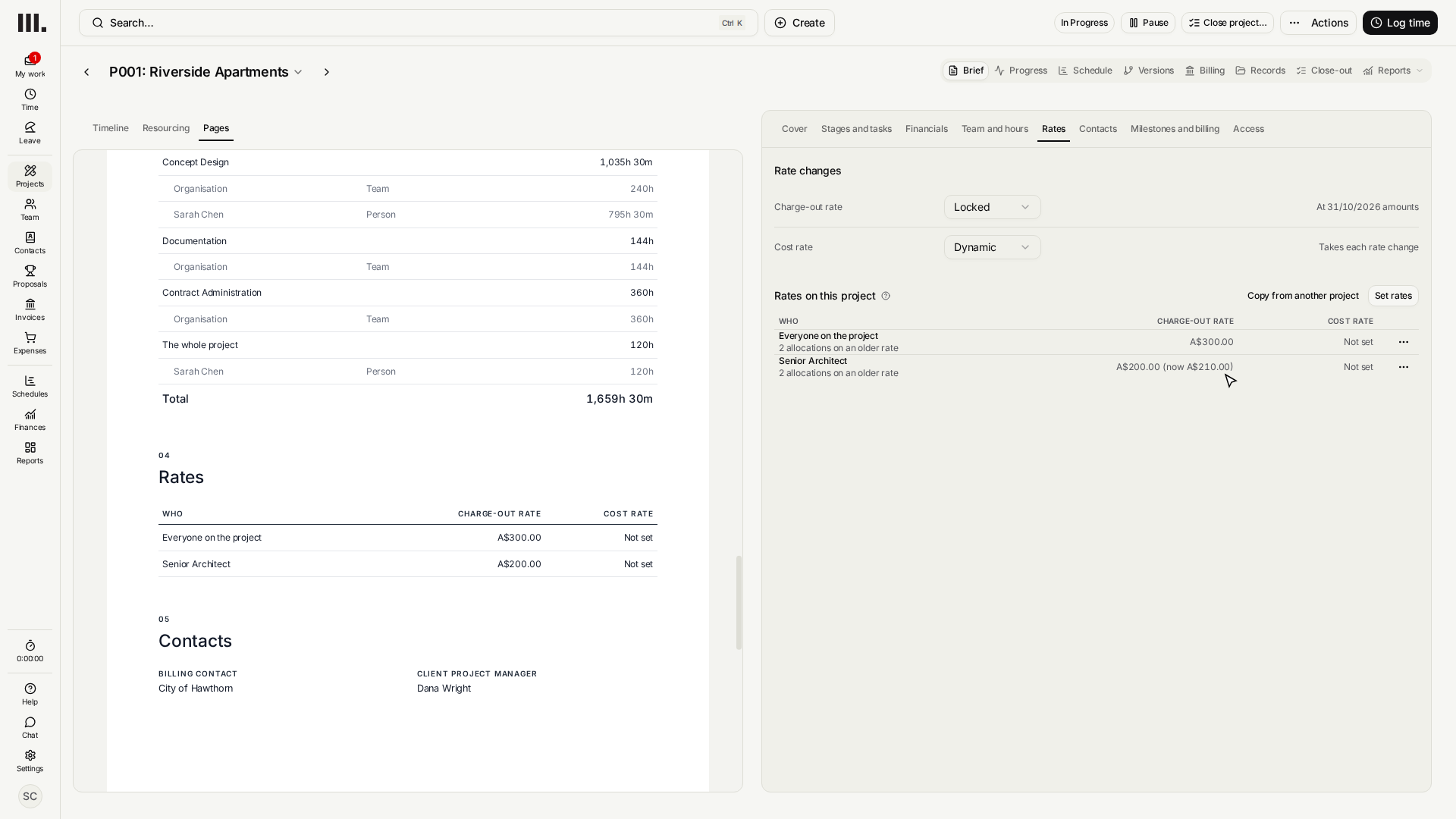
To change either side, choose Locked or Dynamic in its dropdown. Locked locks from today. The switch prices the project's bookings and recorded time again from the lock day; invoiced time keeps its charge-out rate. Both offer Undo.
Agree a rate with the client
An agreed rate is set on this project only. It wins over the role's and the person's own rate here, and it stays put whether the project is Locked or Dynamic: rate changes elsewhere never move it.
- 1
Under Rates in use, click Set rates.
- 2
Set For to A role and choose Senior Architect. Type one hundred and ninety in Amount an hour. What it changes shows each person's new rate before you save.
- 3
Click Save. Sarah's booked hours move onto the agreed rate, and the Senior Architect row reads one hundred and ninety, agreed for this project.
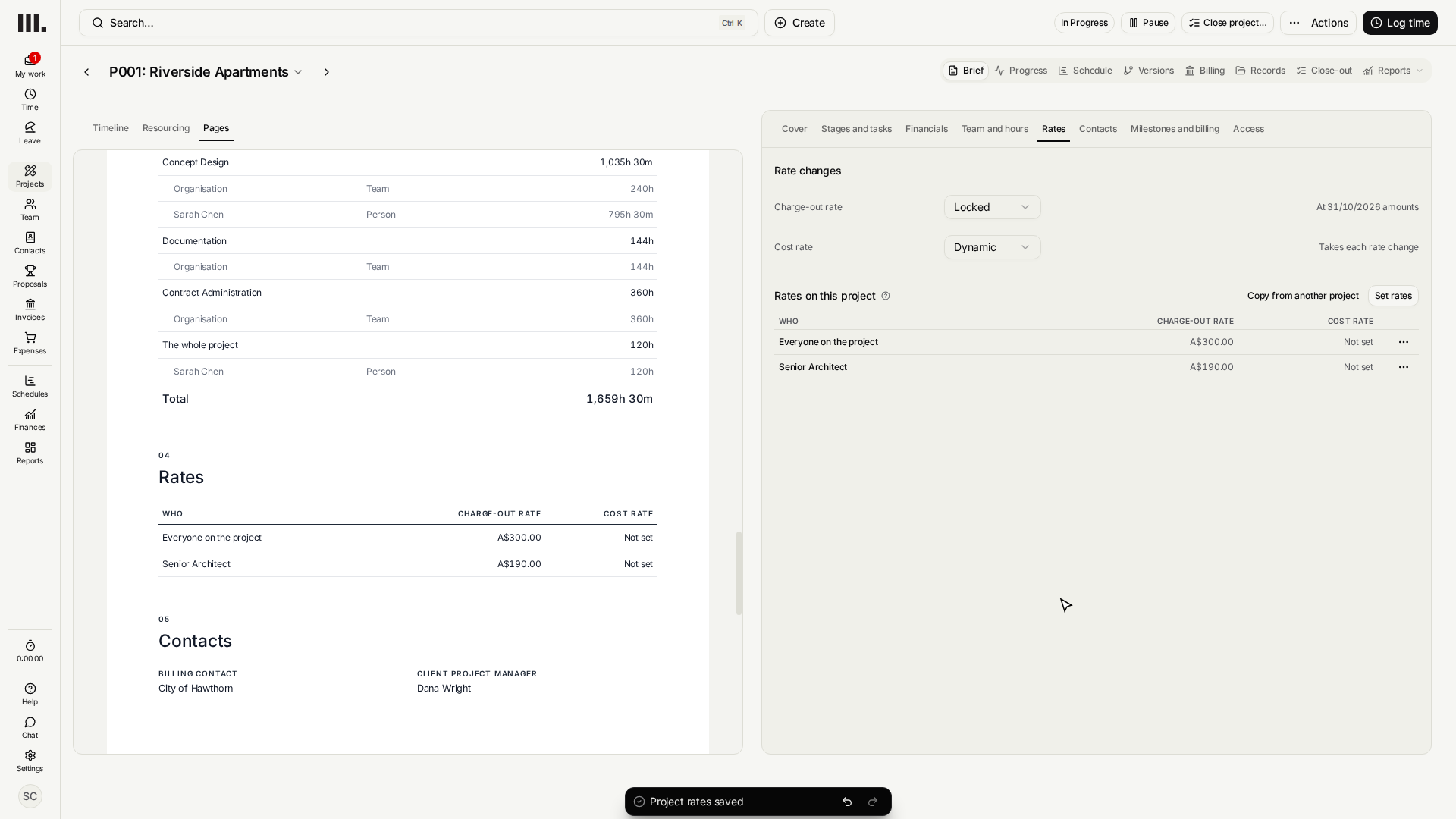
For can also be Chosen people, such as outsourced staff on a discounted rate, or Everyone on the project.
Override one person's rate
Each row's menu has Override charge-out rate… and Override cost rate…. The Override dialog sets this person's or role's rate on this project only. Under Use, choose:
- A project rate: an amount an hour.
- An amount from the rate history: one of the role's or person's earlier amounts.
- A rate type, when the practice has added rate types.
Fee letters often step the rate up partway through: after a stage, or at the start of the next financial year. Pin the new amount to that date instead of overwriting the old one.
- 1
Open Sarah's row menu and click Override charge-out rate.
- 2
Type one hundred and ninety-five in Amount an hour.
- 3
Switch on Pin to a date and set Starts on to the first of next month. With the switch off, the amount covers every date and replaces the override's other amounts.
- 4
What it changes lists Sarah's work and the rate each part takes. Click Override rate. Open the dialog again and switch on Pin to a date: each amount is listed with the date it starts, with Change and Delete.
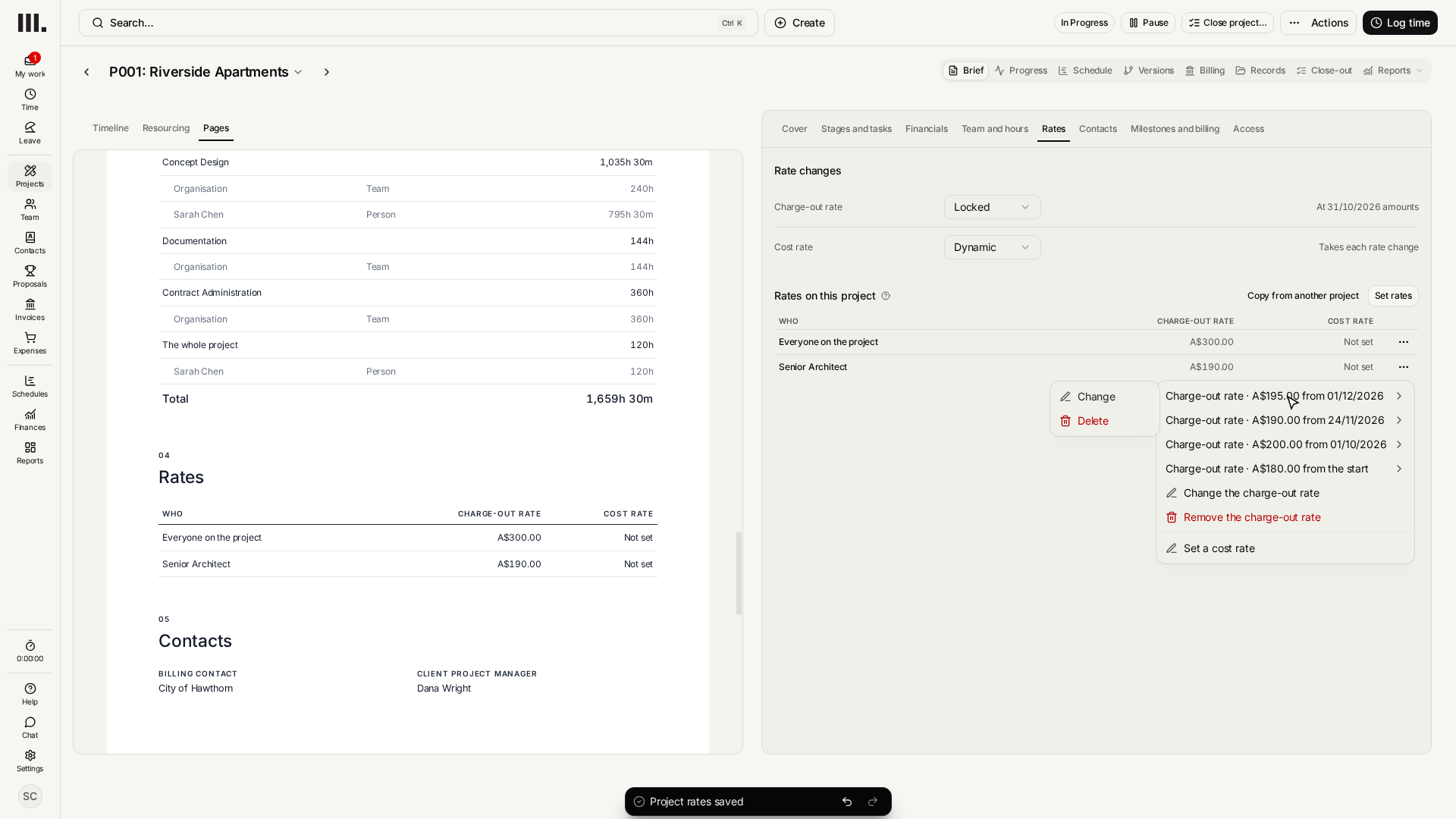
An override reprices all of the person's work on this project: booked hours and recorded time. Time already on an invoice, draft or sent, keeps its charge-out rate and takes the new cost rate, and the invoice does not change. A pinned amount only reprices work from its date.
To put them back on their role's or own rate, open the row's menu and click Remove charge-out override. Their work on this project goes back to that rate, with Undo. To change the rate they follow on every project, click the link at the bottom of the Override dialog, such as Change Senior Architect's rate for every project.
Rates for one stage or task
Sometimes one part of the job is priced differently: contract administration at a reduced rate, or a stage quoted on figures that must not move. Under Tasks, every stage and task of the project is listed, collapsed. Each one says what its rates are:
- Same as the project: it has no setting of its own. It uses the project's rates and its Locked or Dynamic choice, and follows every later change to them. A task under a stage that sets its own reads Same as that stage.
- A task that sets its own says so, such as Charge-out Locked at 30 Sep 2026 · Cost Dynamic · 1 rate of its own. Its setting covers the tasks under it too.
- 1
Under Tasks, click a task to open it. Charge-out rate and Cost rate show Locked or Dynamic as the task takes them, and every person and role with work on the project shows their rate on this task and where it comes from.
- 2
To agree a rate for this task, click Set rates. Choose who it is for, the rate and the amount an hour, and click Save. It is used instead of the project's rate on this task.
- 3
To keep this task's amounts whatever happens to the project, open the task's menu and click Lock this task's rates. Both sides lock from today. Or choose Locked or Dynamic for one side in the open task.
- 4
To undo all of the task's own rates and choices, open its menu and click Use the project's rates. It reads Same as the project again.
Every change also prices the time recorded on the task again; invoiced time keeps its charge-out rate. Every change offers Undo.
Troubleshooting
- A row says some allocations are on an older rate. An earlier change left them on the old rate. Open the row's menu, click Override charge-out rate, and click Override rate: every allocation and time entry moves onto it, and invoiced time keeps its charge-out rate.
- The project ignores a role rate rise. It is Locked, or it has an agreed rate for that role. The brackets show what the role charges today.
- One task charges differently from the rest. It, or a stage above it, sets its own rates. Under Tasks, its line says so; click Use the project's rates in its menu to put it back.
- Copy the same rates to another job. Click Copy from another project on the project that needs them, and choose the one to copy from.
Where this fits next
Hours worked before and after a rate change bill at the rate each was worked at. To set a role's own rates, see charge-out and cost rates.
Search Monument help
Search help articles and open a result.